|
GE Successfully Trials Breakthrough High Temperature Superconducting Technology for Next Generation Power Generation
4/10/2013 |
|
|
"Hydrogenie" compact power generation technology tested in Rugby, England, runs at 50 Kelvin
GE's Superconductive technology research offers significant advantages in efficiency as well as size, mass and weight reductions compared with conventional machines
Impact on production of energy from alternative energy sources could be substantial
PARIS - April 4, 2013 - GE's Power Conversion business (NYSE: GE) has taken an important step in testing a viable way of producing large amounts of electricity from renewable resources using superconductors running at relatively high temperatures.
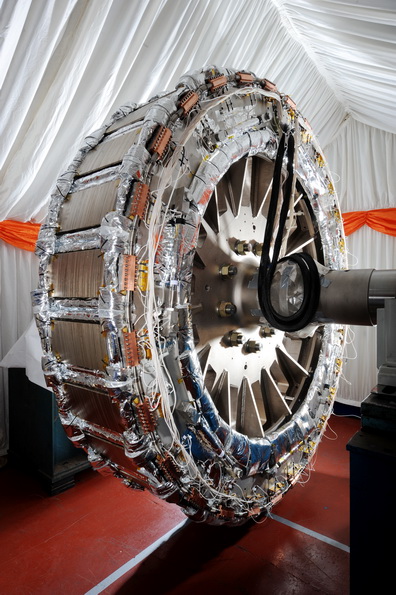
The company has successfully completed trials of Hydrogenie, a power generator incorporating ground breaking technologies that enable highly efficient production of electricity in a small space. Hydrogenie makes use of superconductors instead of copper for the rotor windings on the motor, operating at 43 Kelvin, or -230ºC. It was tested late last year up to and well beyond its full rated load 1.7MW spinning at 214 rpm, and met expectations and design predictions. The tests were carried out at a GE Power Conversion facility in Rugby, England.
Until recently, superconductivity could only be achieved at around 4K (-269ºC). But new "high temperature superconductors" (HTS) exhibit the phenomenon at much higher temperatures. Such machines will need less complex insulation systems and less powerful cooling than used hitherto on devices such as medical MRI magnets.
"This technology is a true breakthrough," says Martin Ingles, Hydrogenie project manager at GE Power Conversion. "It could radically improve the efficiency of equipment producing electricity from water and from wind, and may also be suitable for further applications down the road."
Latest superconductors are made by depositing a superconducting layer of ceramic onto a relatively cheap base metal. They have virtually no resistance to electrical current when cooled to very low temperatures, so windings can be made with wires having a cross section around 2% that of a conventional copper wire winding.
More windings can be fitted into electromagnet coils, resulting in a higher power magnet that is substantially smaller or lighter than before. Superconductivity offers significant advantages in efficiency, and significant weight reductions compared with conventional machines. The greatest benefits in terms of size and mass reduction are for applications where high torque machines are typically used, most likely as a direct drive application in installations such as wind turbines, ship propulsion or run-of-river hydro plants.
GE has overcome significant technical challenges relating to the cryogenic cooling and thermal insulation required to keep the superconductors at the required temperature. Extremely cold helium gas is piped through a rotating coupling into the machine rotor and then circulated around the individual coils. "It's rather like trying to keep ice cubes frozen on a rotisserie in a very hot oven," says Ingles. "Except that our rotisserie is rather high tech."
The rotor is located inside a vacuum, but still has some direct contact, via its shaft, with the outside world. This creates issues relating to the massive temperature differences along the shaft.
The machine incorporates a patented method for transferring torque from cold HTS coils to the machine rotor. Low resistance thermal joints and assemblies ensure that low cooling power is required to cool the coils. In fact, the machine demonstrates all of the technologies required to make HTS machines a commercial reality. GE's Power Conversion business did much of the development of the Hydrogenie 1.7 MW 214 rpm HTS generator as part of the EU Framework Programme 6 funded project that ran between 2006 and 2010.
The successful completion of the Hydrogenie project will set the framework for continued research and development in the study of superconducting machines. One specific area that may potentially benefit in the future is the upgrading of older run-of-river power plants. Coupled with running the machine/turbine at variable speed the benefits could allow efficiency improvements of up to 12% at part load.
The technology building blocks developed as part of the project will also be used in other businesses where high torque and slow speed machines are in use. The most immediate areas of demand are in wind power generation and in marine propulsion.
A superconducting wind turbine generator may permit significant reductions of mass mounted on the tower, thus helping to reduce the cost for the tower itself and its foundations. Recent studies conducted for GE Power Conversion show that the lifetime energy saving for a superconducting wind turbine compared to a conventional machine could be as much as 20%, for offshore or desert machines above 10MW.
On ships, HTS technology combined with DC or variable AC systems can result in up to 4% fuel savings, while the reduced size of the motors will be attractive to naval architects leaving more space for payload or passengers.
Other partners in the EU Framework Programme 6 funded project, "Development and field testing of a compact HTS hydro power generator with reduced investment costs, lowered environmental impacts and strongly improved performance to reduce the price per KWh," were: Zenergy Power; KEMA Nederland; Stirling Cryogenics & Refrigeration; Silesian University of Technology; Cobham CTS; E.On Wasserkraft.
|
|
|
|
|
|
主站蜘蛛池模板:
加勒比久久AV|
99无码精品二区在线视频|
国产区精品福利在线熟女|
自拍偷拍综合第一页|
亚洲成av人片天堂网站|
在线无码免费的毛片视频|
无码激情亚洲一区|
日韩伦人妻无码|
思思久99久女女精品|
国产精品久久国产精品99 gif|
国产福利酱国产一区二区|
欧洲无码成人|
正在播放肥臀熟妇在线视频|
337p粉嫩大胆色噜噜噜|
丁香五月亚洲综合在线国内自拍|
人妻无码中文久久久久专区|
部精品久久久久久久久|
日韩av在线不卡一区二区三区|
伦理片午夜视频在线观看|
中文字幕丰满孑伦无码精品|
亚洲aⅴ无码天堂在线观看|
大地资源网第二页免费观看|
国产成人精品1024免费下载|
香蕉人妻av久久久久天天|
国产乱子伦精品视频|
少妇人妻av无码专区|
岛国av无码免费无禁网站|
免费吃奶摸下激烈视频|
一个色综合国产色综合|
国产熟女a?v|
又湿又紧又大又爽A视频男|
小鸟酱足交|
精品久久久久久蜜臂a∨|
国产aⅴ丝袜旗袍无码麻豆|
日韩中文字幕综合第二页|
亚洲精品国产成人无码区在线|
色猫咪av在线网址|
丰满少妇人妻无码专区|
国产老熟女无套内射不卡|
婷婷综合五月|
国产亚洲网|